Vignettes in Memories: Blooming Tranquillity
In Conversation with Nohana Sayama
Curated by Sylvia Liu
1. What are your top three comfort foods? Congee, Sōmen (素麺), Instant ramen
2. Describe your last meal before you left home? Sushi
3. If you were a flavour, what would you be? Bubblegum
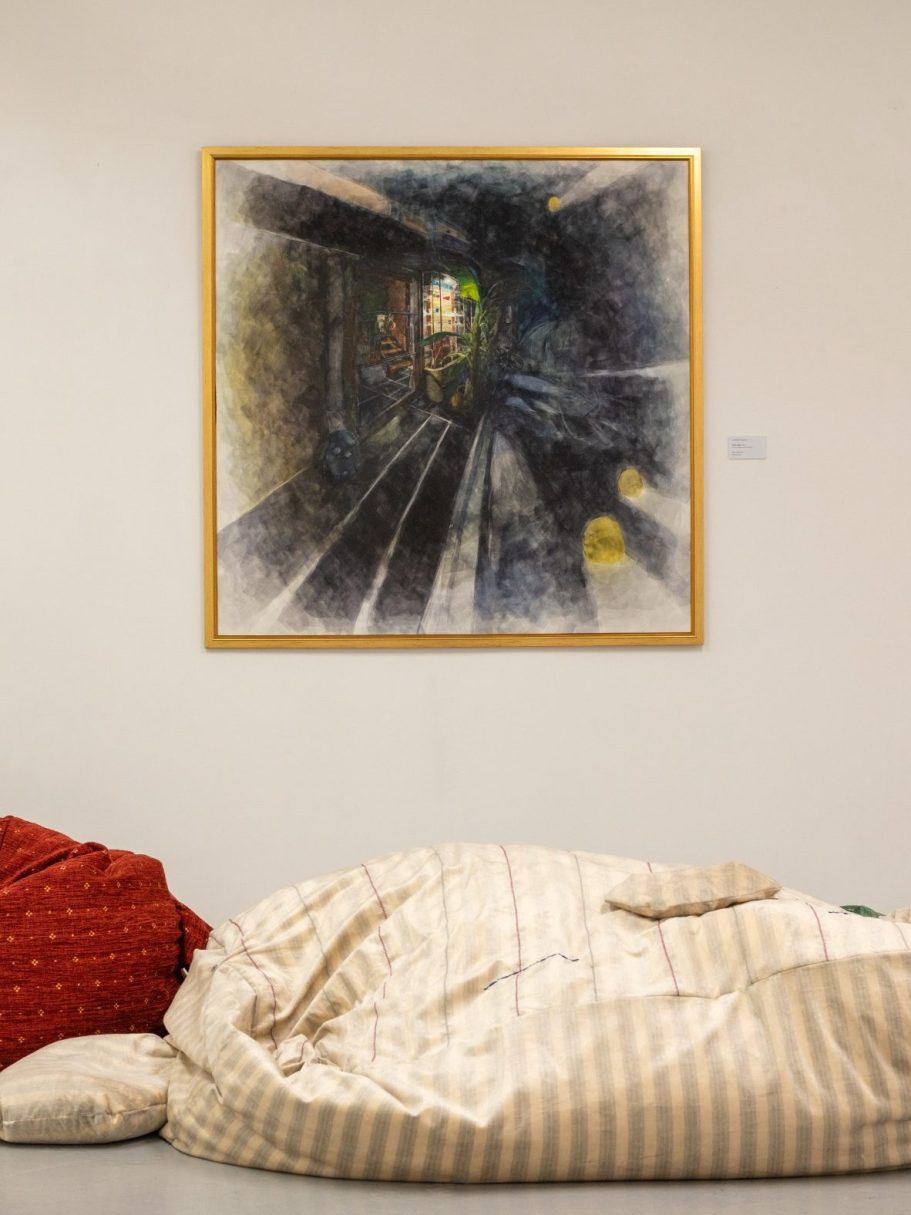
The theme in Nohana Sayama’s works, “vignette”, originates from a yearning for belonging and remembrance. With her upbringing as an expatriate living in multiple countries, she was exposed to and absorbed many cultures through meeting people. However, it forced countless goodbyes, shaping her identity. She began to conceptualise each location she inhabited as an anti-chamber. Each work is a snapshot, a diary entry from the lifelong search for a final resting place; they are attempts to capture the space when she was present: of when it knew her, acknowledged of her existence.
Sylvia:
That's very interesting! Also, I heard there are little creatures in every one of your paintings that are inspired by the little stone sculptures by the road, right? What's their story?
Nohana:
Those characters originated as a self-portrait, with yellow representing how Asians are stereotyped, a flat nose because in Japan it's considered unattractive, and no mouth, as you're not supposed to stand out. Eventually, I started including them in my paintings because I had a personal connection with them that wasn't immediately obvious. They just felt comforted in their presence, so I thought that maybe it doesn't even have to be my racial representation; it could just be a character that I find comforting, one that doesn't mean anything else.
The Jizos influenced those creatures in my paintings; Jizo's job is to be placed on the side of the road and to look after travellers in neighbourhoods. And they also have less-known jobs of guiding little kids who've died at a younger age to get them into heaven. So they've always been guides, and they're used here and there for different purposes; their presence is comforting. My characters don't have names, nor do they speak, because all they do is gently observe you and be there.
Sylvia:
Let’s start with more general questions about your practice. Your work centres on “vignettes”, a term usually used in photography. Why do you use that approach?
Nohana:
My paintings are all about memory; it's about all the things that happened in the past that are blurry and have already started fading. Making it look like a vignette suits my perception of the past and memory because that's what you see. That central bit that you did focus on, you have an apparent memory of, but everything else fades. So yeah, that's why I use vignettes.
Sylvia:
You mainly use Gansai watercolour in your paintings, and you mentioned it is related to your Japanese heritage. Is it like an anchor for your work to represent that part?
Nohana:
I think so! I spent a total of 12 or 13 years growing up in Japan, but I don't have many memories. I was influenced partially, but not entirely, as I've moved frequently and been exposed to various cultures. So, there is a will within me to have something that connects me back to my heritage; I know it makes up for me partially. I started with British watercolours but switched to Japanese Gansai because I wanted to know where I came from, heritage-wise. And I also wanted to understand why people use that medium. And turns out it's excellent! I love the saturation, I love the depth of colour it has, I love how it lets me layer dramatically. So it was meant to be.
Sylvia:
Have you ever felt your identity, such as cultural, personal or artistic, was misread, flattened or simplified?
Nohana:
As a Japanese person, this is something that you guys probably relate to as well as East Asians; we get stereotyped easily. A lot of people think Asian art is cheap or just mass-produced, like anime or illustration, never fine art, which I really dislike. Both forms
are precious; illustration happens to be more reproducible. But yeah, if you mean flatten like stereotypes, then definitely.
Sylvia:
Our exhibition concept revolves around interdependence, cultural in-betweenness, and non-fixed identity. How does that resonate with you?
Nohana:
I don't have a fixed identity, and I also don't have a cultural identity, because I've moved around a lot. I'm extroverted, and I depend on my communities wherever I go. Spaces matter to me because the people in them make me want to come back; to repaint it, to remember that specific moment, the smell, the space, and all the interior that was within it. I like the idea that we shape spaces by existing in them, and they lose that 'home' feeling when we leave.
Sylvia:
I like that! You mentioned you don't really have a cultural identity; are you feeling eager to shape one, or are you fine with your current state?
Nohana:
I'm pretty satisfied with my current state. There is that insecurity that I don't belong anywhere, and I don't have a home to refer to. I mean, I do, that's my parents' house back in Japan. However, there were also other homes that I would have loved to refer to, but that is no longer our position. There is, however, a particular kind of insecurity and sadness to it. However, as someone younger, I have many years ahead of me to explore new cultures. And I've reached a point where I've accepted that I have this insecurity, and it's likely to follow me around for a while. My art is my outlet; it helps me process that insecurity. As long as I keep making work and have a story to tell, it's all good. Plus, the community I form around myself and my partner all get the whole 'global citizen' vibe, so I feel at home with them.
Recipe.
Blooming Tranquillity
Sōmen 素麺
For the dipping sauce
- 2 Tbsp soy sauce
- 2 Tbsp mirin
- 1 tsp hondashi (ほんだし, bonito flavoured seasoning)
- 150 ml water
1. In a saucepan, combine soy sauce, mirin, hondashi (bonito flavoured seasoning), and water. Bring to a boil and set aside to cool.
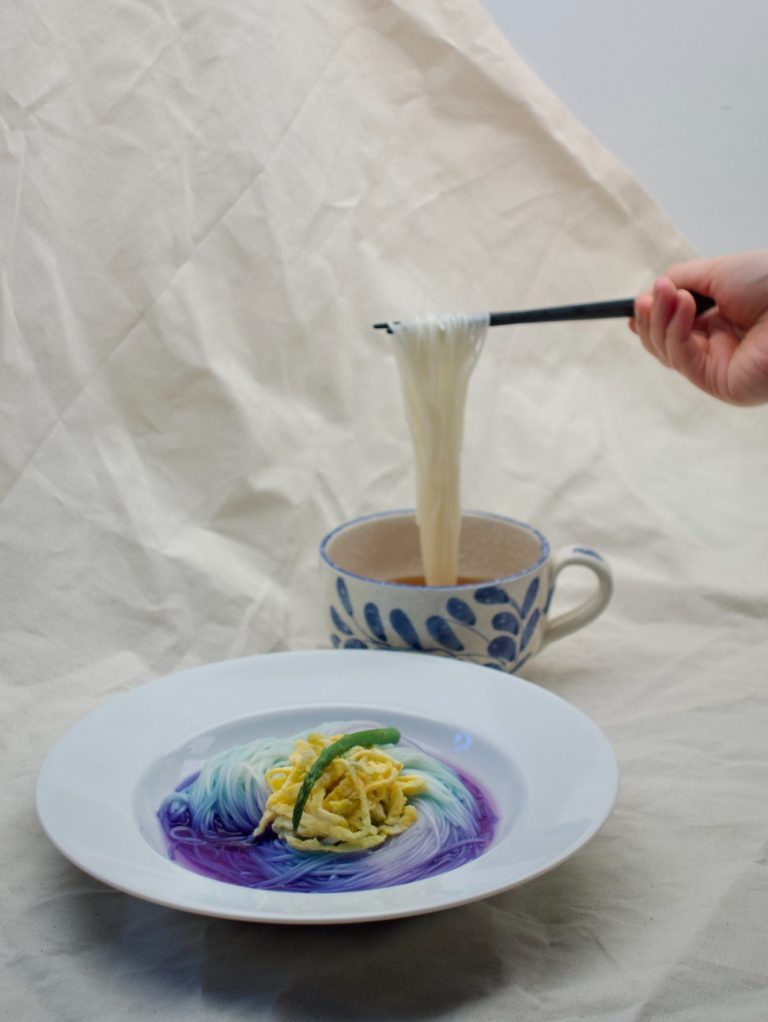
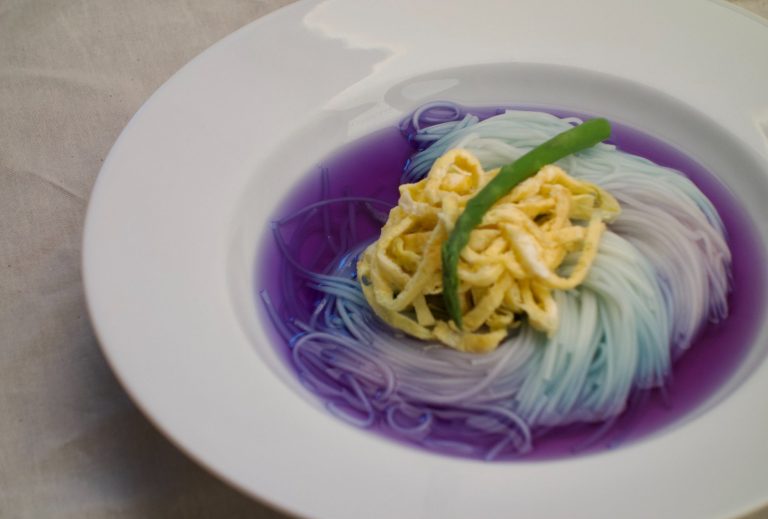
Sōmen (素麺) is traditionally served cold during the summer in Japan, accompanied by a simple bonito-flavoured dipping sauce. This preparation highlights the delicate craftsmanship of the thin noodles, offering a dish that feels both hearty and grounded. This version puts a playful twist on the classic: instead of serving the noodles in ice water, they’re presented in
bubblegum-coloured iced tea to keep them chilled, with a drizzle of lemon to spark the flavours of summer. Nohana mentioned sōmen as her comfort food, and her artwork radiates warmth and tranquillity, contrasting her vibrant, bubbly energy that inspired this recipe.
For the butterfly pea flower tea
- 1 g dried butterfly pea flowers
- 150 ml water
1. Bring water to boil and put in the dried flowers to steep, it should give you a lovely blue coloured tea.
2. Set aside to chill.
Noodle cooking instructions
- 100 g Ibonoito (揖保乃系) sōmen noodles
1. Bring a pot of water to a boil, then add the sōmen noodles.
2. Turn off the heat immediately, cover the pot with a lid, and let it steep for 5 minutes.
3. Strain the sōmen and chill them in ice water.
Assemble
1. Strain the chilled sōmen and plate it in a deep dish with a few ice cubes and butterfly pea flower tea. Then, drizzle some lemon juice to create an ombre effect of blue and purple in the tea.
2. Garnish with the toppings of your choice, such as cucumber, green onion, or egg floss, or serve as is.
3. Pour the chilled dipping sauce into another small bowl.