Textured Dialogue:
Sensing the Spice
In Conversation with Iris Yi-Tyng Lin
Curated by Sylvia Liu
1. What are your top three comfort foods? Hotpot, Shin Ramyun, Fried Chicken
2. Describe your last meal before you left home? Beef noodle at the Taoyuan Airport
3. If you were a flavour, what would you be? Savoury and Spicy
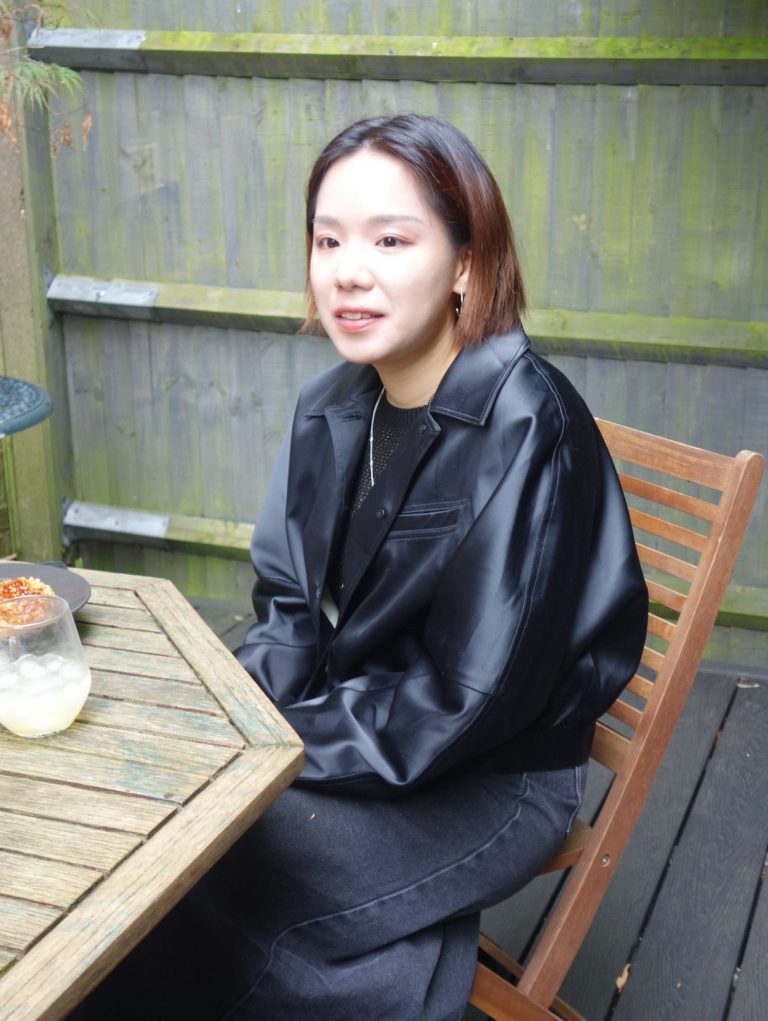
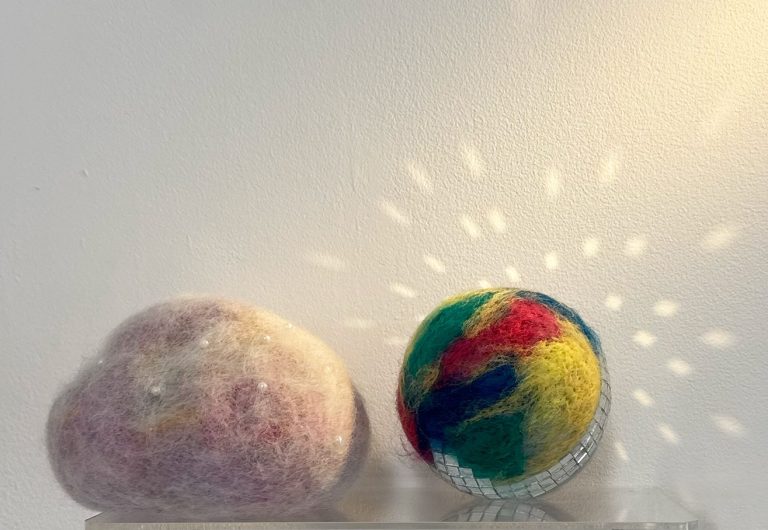
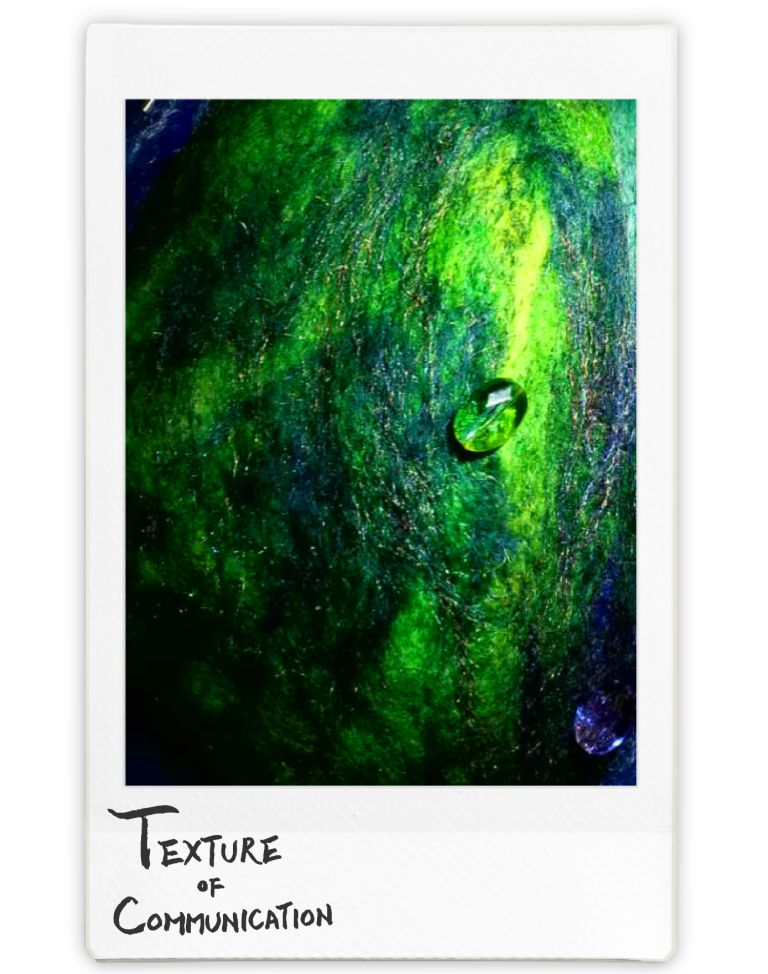
Iris Yi-Tyng Lin’s work explores the nuances of communication in daily life — the tones, gestures, and unspoken layers that shape how we connect with others. Iris’s practice often begins with conversation, weaving research with poetic expression to translate intangible experiences into visible, touchable forms. Her work Texture of Communication is a series of felt sculptures developed through one-on-one dialogues. Each piece embodies a participant’s way of speaking, listening, and relating, paired with an imagined ‘B-side’ — a self unlike the present. By imagining this self, she opens the possibility of reaching toward someone different from her.
Sylvia:
Let's start by discussing your creative practice. How did you decide to work with felting as your medium?
Iris:
I had some prior experience with felting, and when I began this project, I wanted to create something tangible, like a 3D sculpture. Felting offered me more flexibility and potential as a medium, especially since I'm not formally trained as a sculptor or artist. I also appreciate the texture, shape, and how colours blend so naturally through felting.
Sylvia:
You mentioned the idea of tangibility, which I find intriguing. What are you trying to convey through these tactile felting sculptures?
Iris:
My project centres on communication, specifically non-verbal communication. I aim to explore all the senses — touch, hearing, smell, colour, shape — everything except spoken words. My research began with a question: how can we communicate with people who hold opposing views? I noticed that people often become defensive or avoid conflict. I want to illustrate the possibility that two people with vastly different beliefs can coexist peacefully in the same space and visually convey this concept.
Sylvia:
I understand. Your working method involves interviewing others. Could you share more on this process?
Iris:
I'm interested in learning about my participants' backgrounds and environments, and how these factors shape their values, beliefs, and identities. Understanding their context helps me comprehend why they communicate the way they do.
Sylvia:
How do you translate what you learn from these interviews into your felt sculptures? What kind of questions do you ask, and how do you capture their identities through felting?
Iris:
It's a step-by-step process. Initially, I ask about the participants' life stories, how their upbringing and environment influenced their identities. Then I inquire about their current relationship with the world and communication styles. I ask them to visualise their state emotionally: if it were a shape or colour, what would it be? Would it feel heavy or light? These responses guide the form and texture of the sculpture.
Sylvia:
That's fascinating. Does this process of exploring others' identities also shape your own? Is it a way for you to gain a better understanding of yourself?
Iris:
Definitely. My approach to communicating with people has evolved through this project. I have noticed patterns of similarity and difference among participants and gained insight into various communication styles, which have influenced my own identity.
Sylvia:
Was there anyone you interviewed who left a powerful impression on you?
Iris:
The first interviewee was a painter. She described her current state as still searching for what she wants to achieve and how to do so. I resonated deeply with that. She visualised a fluffy, rounded shape to represent this feeling, which resonated with my own emotions. Before coming to London, I worked as a UX and graphic designer in Taiwan, where art felt distant to me; I never thought I could be an artist. But in London, especially after my last exhibition, anything is possible. I'm currently in a transitional phase, exploring new possibilities.
Sylvia:
I noticed your online journal and project pamphlet are in Taiwanese (臺語). Is there a political intention behind this choice?
Iris:
In a way, yes. Stating I am Taiwanese is inherently political. Some might avoid making that explicit, but I see no reason to be afraid. It's part of my identity, and I want to express it openly.
Sylvia:
So you're not avoiding the political dimension, but do you see it as intentional or something that unfolded naturally?
Iris:
My work is an exploration of self, which naturally connects to political statements. I am aware of the political implications and choose not to shy away from them, so yes, it's intentional.
Sylvia:
Do you consider London your home? Do you feel a sense of belonging here?
Iris:
That's a complex question. I recently spent a month in Japan, and when I returned to my flat in London, I felt ‘at home’ in that space. But London isn't my home in a more profound sense. When asked about my last meal before leaving ‘home’, I still said Taiwan. As for belonging, I sometimes feel comfortable here because of London's diversity.
Sylvia:
Are you someone who actively seeks a sense of belonging?
Iris:
I may not actively seek belonging. I make myself comfortable wherever I am. I've moved around a lot, so adaptability is key for me; not necessarily fitting in, but surviving different environments. That said, I do try to connect with the Taiwanese community here by participating in events, so I may find a sense of belonging in my own way.
Sylvia:
What motivated you to engage with these themes in your work?
Iris:
As Taiwanese, we are often a minority on the global stage, and our voices can be drowned out. I want to express that we are here. Living abroad has deepened my connection to my identity. For example, I use Taiwanese (臺語) in my work and have a strong desire to write poetry in it, something I never felt motivated to do when in Taiwan. Being in London, I think this is the right time to explore this.
Recipe.
Sensing the Spice
Shin Ramyun Fried Chicken
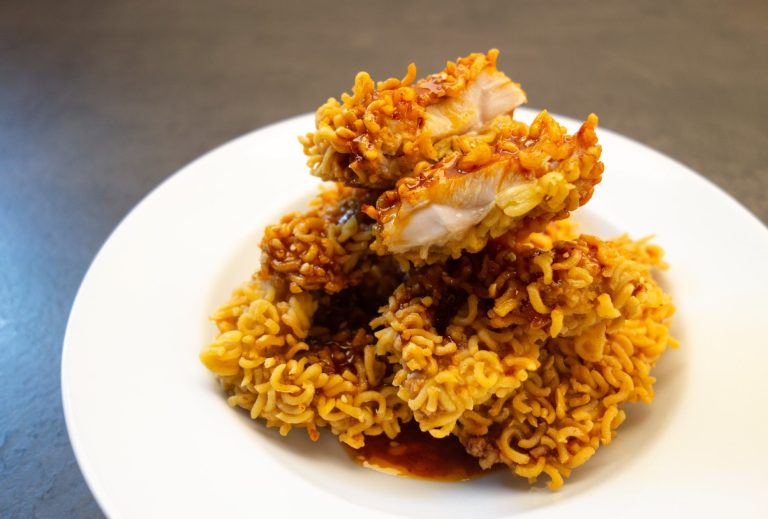
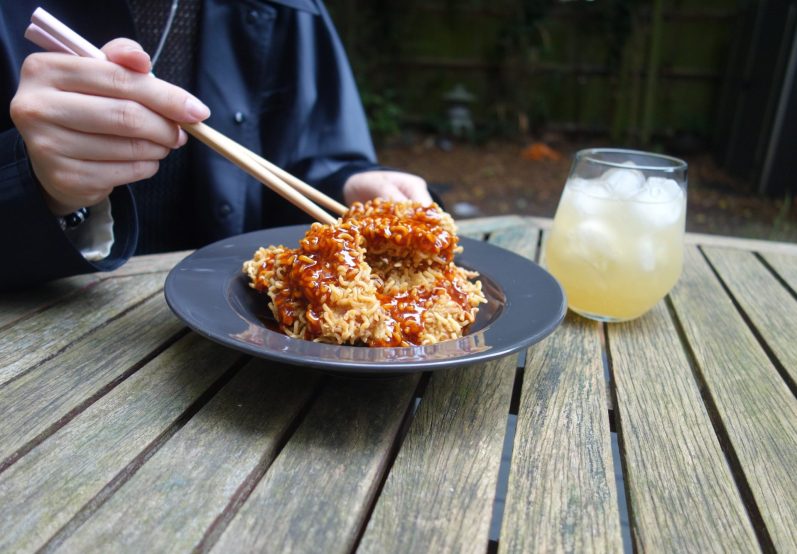
Inspired by Iris's exploration of materiality and texture, the curator created a fried chicken dish enhanced with the distinctive crunch of Shin Ramyun. These two elements evoke a sense of comfort for Iris. This dish serves as a multisensory extension of Iris's journey, allowing the curator to engage with her narrative not only through dialogue but also through taste and tactile experience.
Instructions
- 2 packs Shin Ramyun
- 2 skinless chicken thighs
- 1 Tbsp oyster sauce
- 1 Tbsp soy sauce
- 1 Tbsp cooking sake
- 2 Tbsp gochujang
- 1 Tbsp honey
- 1 Tbsp soy sauce
- 1 egg
- 50 g all-purpose flour
- Sunflower oil
1. Chop the chicken thighs into bite-sized pieces, and marinate them with oyster sauce, soy sauce, and cooking sake.
2. Open two packs of Shin Ramyun, and crush the ramen in a separate bag into crumbs.
3. Prepare the breading station by placing one plate with beaten egg, another plate with flour, and a last plate with crushed Shin Ramyun.
4. In a saucepan, combine gochujang, honey, soy sauce, the two seasoning packets from Shin Ramyun, and a splash of water. Stir together and bring it to a boil, then turn off the heat.
5. In a large, deep pan, heat the sunflower oil until a chopstick is bubbling.
6. Coat the marinated chicken with the order of flour, egg, and Shin Ramyun crumbs; deep-fried in the sunflower oil until golden brown.
7. Drizzle the sauce on the fried chicken, and serve.